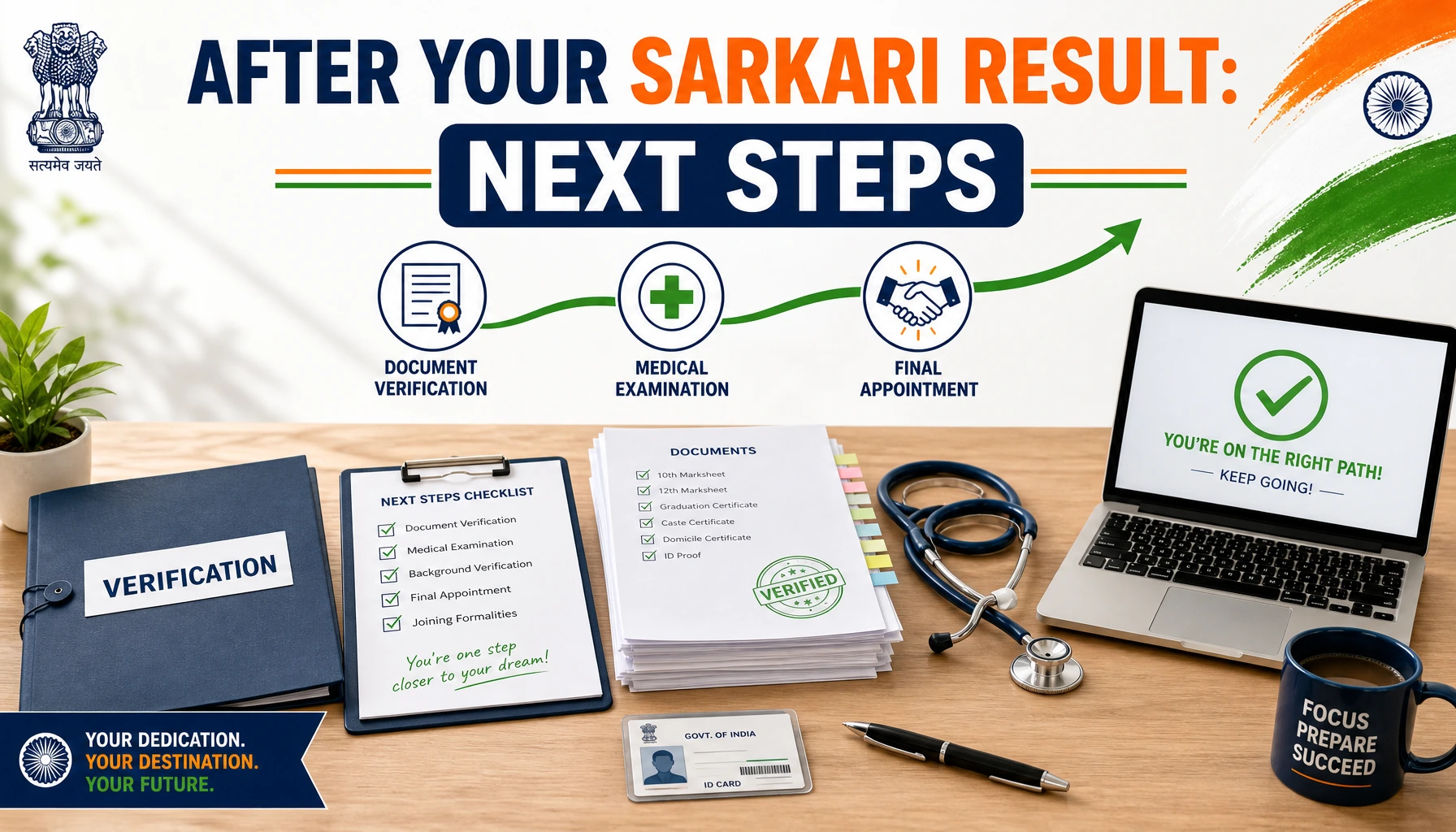
Clearing a government exam is a huge milestone, but the result declaration is not the finish line. Between the day your roll number appears in the merit list and the day you sign your joining report, there is a structured process involving document verification (DV), medical examination, police verification, and finally the appointment letter. Many candidates lose their hard-earned selection at this stage due to small, avoidable mistakes — a missing certificate, a mismatched name spelling, or a missed deadline.sarkari naukri
This guide walks you through every stage that follows a sarkari result, what documents to prepare, common reasons for rejection, and how to protect your candidature until you officially join.
Stage 1: Read the Result Notice Carefully
The result PDF is more than just a list of roll numbers. Along with the merit list, the recruiting body (SSC, IBPS, RRB, UPSC, State PSC, or the department itself) usually publishes:
- Your category-wise cut-off and whether you have been selected under your own category or on unreserved merit.
- Whether the result is provisional — most results are, subject to document verification.
- The next stage schedule: DV dates, medical examination dates, or instructions to wait for communication from the allotted department or zone.
- Post/department preference status — in exams like SSC CGL, your final post allocation depends on your rank and the preferences you filled earlier.
Download and save the result PDF, the official notice, and your scorecard immediately. Websites often remove old files, and you may need these later during joining or even years into service.
Stage 2: Document Verification (DV)
Document verification is where the majority of post-result rejections happen. The recruiting body checks whether everything you claimed in your online application — age, qualification, category, domicile — is backed by valid original documents.current affairs
Documents you will almost always need
- Matriculation (10th) certificate — this is the legally accepted proof of your date of birth. The name and DOB here must match your application form exactly.
- Educational qualification certificates — degree/diploma certificates and all semester or year-wise marksheets. If your final degree certificate is not yet issued, carry the provisional certificate plus all marksheets.
- Caste/category certificate (SC/ST/OBC-NCL/EWS) — in the prescribed central or state government format. OBC-NCL and EWS certificates must be valid for the relevant financial year mentioned in the notification. An expired or wrongly formatted certificate is one of the most common reasons for candidature cancellation.
- Photo ID proof — Aadhaar card, and often PAN, Voter ID, or passport as secondary ID.
- Admit cards of all exam stages — Prelims, Mains, Skill Test/Typing Test as applicable.
- Recent passport-size photographs — usually the same photo you uploaded in the application, plus fresh ones. Carry 8–10 copies.
- Domicile/residence certificate — for state government jobs and posts with local-language or residency conditions.
- NOC from current employer — mandatory if you are already working in a government or PSU job.
- Disability certificate (PwBD candidates) — issued by a competent medical authority in the prescribed format.
- Ex-servicemen documents — discharge book/certificate and undertaking, where applicable.
Golden rules for DV
- Carry originals plus two sets of self-attested photocopies of every document.
- Name mismatch is a silent killer. If your name spelling differs across your 10th certificate, degree, Aadhaar, and application form, get an affidavit or gazette notification prepared in advance and carry newspaper clippings if a name change was published.
- Category certificate date matters. Many notifications require the certificate to be issued before a specific crucial date (often the application closing date). Read your original notification again before DV day.
- If any document is genuinely unavailable, most boards allow you to submit an undertaking and produce it within a stipulated time — but never assume this; confirm from the DV notice.
- Reach the venue early, dress formally, and keep documents arranged in the order listed in the DV notice inside a transparent folder.
Stage 3: Medical Examination
After (or sometimes alongside) DV, selected candidates undergo a medical examination as per the standards of the post.
What the medical typically covers
- Vision test — distant and near vision, colour blindness (critical for Railways, Police, Defence, and driving posts). Railway posts are classified into medical standards like A1, A2, A3, B1, B2, C1, C2 — check which standard your post demands.
- Physical measurements — height, weight, chest expansion for uniformed posts (Police, CAPF, Defence, Forest services).
- General health — blood pressure, blood and urine tests, ECG or X-ray in some services.
- Hearing test and examination for knock knees, flat foot, squint, or varicose veins in physical-standard posts.
How to prepare
- Avoid alcohol, smoking, and heavy medication in the days before the test; stay hydrated and sleep well.
- If you wear spectacles, carry your prescription. Know your post’s vision standard — some posts permit corrected vision, others do not.
- If you have any past surgery or medical condition, carry relevant medical records.
- Candidates declared temporarily unfit are usually given a re-medical date or an appeal window against the medical board’s decision — the appeal typically requires a fee and must be filed within the stated deadline. Do not miss it.
Stage 4: Police Verification & Character Certificate
For most government jobs, especially in central services, railways, banking, and police, a character and antecedents verification is conducted through your local police station.
- You will fill an attestation form giving details of your addresses for the past several years, family members, and any criminal cases.
- Disclose honestly. A pending or even a disposed court case, if concealed, is treated as suppression of material information and can lead to termination even after joining. Disclosure with acquittal is usually manageable; concealment is not.
- Police officials may visit your home address or call you to the station. Keep your documents and ID handy, and inform family members at your permanent address.
Stage 5: Offer of Appointment & Joining
Once DV, medical, and police verification are cleared, the department issues the offer of appointment / appointment letter. Here is what to check and do:
- Verify the letter’s authenticity. Genuine appointment letters never ask for money. Job scams spike after every major result — cross-check any letter on the official department website or by contacting the office mentioned. No government department charges a “joining fee” or “security deposit.”
- Note the joining date and reporting office. Extensions are sometimes possible on written request (for notice periods at current jobs, for example), but never assume — apply formally and get written approval.
- Documents for joining day typically include the appointment letter, all originals verified during DV, medical fitness certificate, relieving letter/NOC if employed, bank account details, PAN and Aadhaar (for salary, NPS/UPS and GPF processing), and passport photographs.
- Fill nomination and service forms — NPS/UPS registration, GIS, family declaration, home town declaration, and oath of allegiance are usually completed in the first week.
- Probation period — most posts carry a probation of 1–2 years. Attendance, training performance, and conduct during probation affect confirmation.
What If Your Name Is NOT in the List?
- Check the waiting/reserve list. Boards like IBPS maintain a reserve list, and SSC conducts post-preference-based subsequent allocations. Vacancies arising from non-joining are often filled from these lists over the following months.
- Apply for your marks and cut-off analysis. Knowing how close you were helps you plan the next attempt strategically.
- RTI is your friend if you suspect an error in your marks or category consideration — but first use the official representation/grievance window if one is provided.
- Keep your preparation warm. The gap between two exam cycles is shortest right after a result, and your syllabus is still fresh.
Common Mistakes That Cost Candidates Their Selection
- Letting the OBC-NCL/EWS certificate expire before DV instead of renewing it in advance.
- Ignoring emails/SMS from the recruiting body — DV schedules are often communicated with short notice.
- Not carrying the exact documents in the exact format listed in the DV notice.
- Concealing a criminal case, previous government service, or a prior debarment.
- Missing the medical appeal deadline after being declared unfit.
- Falling for fake appointment letters and paying “processing fees” to fraudsters.
Frequently Asked Questions
Q1. How long does it take to get the joining letter after the final result? It varies by organisation — anywhere from a few weeks to several months. Railways and SSC allocations can take longer because dossiers are forwarded to individual zones/departments, which then conduct their own DV/medical and issue appointment letters.Online Application
Q2. Is the final result provisional? Yes, almost always. Selection remains provisional until documents are verified, medical fitness is confirmed, and police verification is cleared.
Q3. Can I request a change in posting location? Initial posting is generally as per administrative requirement and your rank/preferences. Transfer requests are usually entertained only after completing a minimum service period, except in special cases (spouse ground, medical ground) as per department rules.
Q4. What happens if I don’t join by the given date? Your candidature can be cancelled and the vacancy passed to the reserve list. If you genuinely need more time, submit a written extension request before the joining date and wait for approval.
Q5. Do I need to resign from my current government job before joining the new one? You need a proper relieving order or NOC. Applying through proper channel earlier makes this smooth; if you applied directly, discuss a technical resignation with your current department to protect past service benefits like pay protection and leave carry-forward.

About the Author
k_jyothi
content writer with 4 years of experience in government job notifications and results. He covers SSC, UPSC, Banking, Railways, and State PSC recruitment updates, providing aspirants with accurate notifications, admit cards, answer keys, and results to support their exam journey.